Hi Everyone
Lou here with ATB. I wanted to share progress with regard to the post-season Tournament of Champions between the All Time Baseball and the Legends of Baseball League's.
Here is the website I propose we use to track the games:
http://www.alltimebaseballsim.net/LOB_ATB_Tournament.htm
The ATB teams are locked in, the LOB teams I took an educated guess on which 4 will participate based upon the playoff results.
The seeding was done as follows:
• WS Winner of each league is the #1 seed and faces the #4 seed of the other league,
• I made the LOB WS winner the #1 seed and the ATB Winner the #2 seed.
• I made the LOB WS runner up the #3 seed, and the ATB runner up the #4 seed.
• If this format works, we'll switch next season.
I haven't been able to confirm much of this with Tom yet, but it is along the same lines of thought we agreed to originally.
The stats on the website were educated guesses too. If you have alternate starting lineups or rotations, just drop me a note and I'll update. The stats were for purely informational purposes only to look at the team match-ups; actual lineups would need to be submitted for game play.
Would love to know any thoughts or suggestions!

A centralized Diamond Mind Baseball league, using every full time player from 1871 'till today.
Tuesday, November 20, 2012
Legends of Baseball vs All Time Baseball Tournament Update
Hey ATB'ers - I posted this earlier in the LOB website. The Tournament is starting up in the next few weeks. Suggestions from the ATB crew are requested as well:


Friday, October 26, 2012
Which Stats does DMB Use?
Brian B asked a great question earlier this week, "What categories does ATB actually use stats from? I seem to remember
that RBI's and Runs aren't even input, I'm assuming wins and losses are
not input for pitchers."
I thought I posted these answers in this blog previously but couldn't find it. Forgive the re-post if this is old news!
Batters
At Bats
Hits
Doubles
Triples
Home Runs
Hit By Pitch
Walks
Intentional Walks
Strikeouts
Sac Flies
Ground into Double Play
- Games, Runs, RBI, and Sac Bunts are not required
- Stolen Bases and Caught Stealing are technically not required, but they are used to determine stolen base ratings
Pitchers
Batters Faced
Innings Pitched
Hits
Home Runs
Hit By Pitch
Walks
Intentional Walks
Strikeouts
- Games, Shutouts, Games Finished, Wins, Losses, Saves, Runs, Earned Runs, Wild Pitches, and Balks are not required
- Starts and Complete Games are technically not required, but they are used to determine durability.
Sunday, October 21, 2012
Comish's Challenge Results
Eight owners participated in the first ever Commissioner's Challenge, a tournament of sorts were the league was asked to create the best team possible using any combination of players. I asked for 16 names per team - 9 person lineup with a DH, 4 starting pitchers, and 3 relievers.
To fill out the roster I gave every team the same back-ups:
To fill out the roster I gave every team the same back-ups:
- Switch Hitting Jorge Posada at catcher (.262 / .333 / .364)
- Justin Verlander as a 5th starter (set to skip) and long reliever (3.60 ERA, 1.24 WHIP)
- Porter Charleston as a long reliever (3.20 ERA, 1.06 WHIP)
- Steve Howe as a back-up lefty specialist (2.56 ERA, 1.04 WHIP)
- And Jeff Gray as a back-up righty specialist (2.74 ERA, 0.94 WHIP)
- (All stats above from the 500 resims)
Incredibly, no two owners featured the same exact lineup. Some notes:
- Only Barry Bonds and Babe Ruth were unanimous choices; and only Bonds was a unanimous choice to play the field as Ruth was both a DH and Right Fielder
- 6 of 8 owners chose: George Brett over 2nd choice John McGraw, Oscar Charleston over Mickey Mantle, and Willie Wells over Honus Wagner
- Three different Catchers, First Basemen, and Second Basemen were selected: Mickey Cochrane, King Kelly, and Bill Dickey; Buck Leonard, Jimmie Foxx, and Lou Gehrig; and Eddie Collins, Ross Barnes, and Fred Dunlap
- Right Field was the most difficult choice with four different possibilities: Ruth, Larry Walker, Stan Musial, and Joe Jackson.
To crown a champion a ran 30 sims and compiled the results:
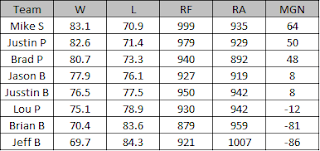

Congrats Mike S who narrowly bested Justin P for the best team. Mike went with a lineup of:
Ted Williams (DH)
Babe Ruth (RF)
Oscar Charleston (CF)
Barry Bonds (LF)
Lou Gehrig (1B)
Fred Dunlap (2B)
George Brett (3B)
Willie Wells (SS)
Bill Dickey ('C)
His rotation was Pedro Martinez, Greg Maddux, Nip Winters, and Randy Johnson. The relievers were Dennis Eckersley, Mariano Rivera, and Gabe White
Justin had a similalr roster, countering with Ross Barnes at second and King Kelly at catcher. Dunlap had 20 points of OPS on Barnes while Dickey had 30 points on Kelly. That appeared to be the difference.
Some other interesting debates:
- Randy Johnson bested Walter Johnson (5.76 ERA vs 6.57)
- Red Ryan bested Mariano Rivera (4.47 vs. 4.72)
- Nip Winters bested Addie Joss and Christy Mathewson (5.67 vs. 6.30 and 8.16)
- George Brett bested John McGraw (.795 OPS vs .685)
- Oscar Charleston over Mickey Mantle (.964 vs .884)
- Willie Wells over Honus Wagner (.819 vs. 774)
Here's a file with all the team by team details.
Thanks for participating. Congrats Mike!
I'll do this again in a few weeks with some alternate ideas (No 30+ HR guys on a roster or something similar in nature).
Tuesday, October 16, 2012
Commissioner's Challenge Update
OK, we have a total of 4 submissions so far, with at least two more on the way.
For those who haven't submitted - scratch the 25 man roster idea. Give me 9 batters, 4 starters, and 3 relievers. For the sim, I will give everyone the same backups.
For those who haven't submitted - scratch the 25 man roster idea. Give me 9 batters, 4 starters, and 3 relievers. For the sim, I will give everyone the same backups.
Great Defenders Who Can Rake
(My definition for "Great Defender" is an Ex range with under an 80 error rate).
Catchers
Mickey Cochrane - Ex/47 with an Ex Arm. .368 OBP with 31 2B
First Base
Buck Leonard - Ex/67. .310 / .360 / .443 with 30 2B and 17 HR
Second Base
Eddie Collins - Ex/61. .295 / .360 / .378 with 25 2B
Third Base
None
Shortstop
Willie Wells - Ex/79. .351 OBP, .490 SLG, 36 HR and 31 2B
Honus Wagner - Ex/74. .302 / .345 / .464 with 43 2B, 13 3B, and 11 HR
Left Field
Fred Clarke - Ex/70. .297 AVG, .353 OBP, 25 2B (admittedly a stretch)
Center Field
Oscar Charleston - Ex/55. .338 / .442 / .625 with 49 2B and 39 HR
Joe DiMaggio - Ex/71. .838 OPS with 34 2B and 28 HR
Pete Hill - Ex/76. .376 OBP, .426 SLG
Tris Speaker - Ex/74 .385 OBP, 42 2B
Hugh Duffy - Ex/73. .309 AVG, .809 OPS, 46 2B, 14 3B
Right Field
Larry Walker - Ex/33. .834 OPS, 35 2B and 35 HR
- There really aren't many great defender/hitter combinations. For the most part, you are lucky if you draft one of these guys.
- Center Field has always been underrated. The position is stacked even more with the negro league entrants.
- Which led me to wonder what the average OPS is for the Top 10 and Top 20 batters at each position:

Well, there you go... sort of. The elite center fielders hit every bit as well as right fielders and first basemen, but there is are stark drop off in talent the deeper you get.
Also interesting is second base, where the Top 5 are incredible. Once you move into the top 10 however, they gain parity with third base, and moving down to the Top 20 they are among the weakest in the game.
Note: I have a few entrants for the Commissioner's challenge. Thanks! Keep em coming.
Monday, October 15, 2012
500 Resims Data and a Commissioner's Challenge
The 500 Resim Data has been fully compiled and can be downloaded here.
For kicks, here is my All Time great ATB team. In other words, this is the ultimate team, the one that I would draft if enjoying free reign to chose at will.
#1 - John McGraw, 3B
#2 - Ross Barnes, 2B
#3 - Babe Ruth, DH
#4 - Mickey Mantle, CF
#5 - Barry Bonds, LF
#6 - Lou Gehrig, 1B
#7 - Willie Wells, SS
#8 - Larry Walker, RF
#9 - King Kelly C
SP 1 - Pedro Martinez
SP 2 - Greg Maddux
SP 3 - Nip Winters
SP 4 - Walter Johnson
CL - Dennis Eckersley
SE - Red Ryan
SE - Gabe White
This was more difficult to compile than I expected. It is fairly simple to figure out who the best hitters are at each position, but constructing a balanced lineup that won't be eaten alive by a lefty pitcher (and one that my pitchers won't resent due to poor defense) is another story.
There are of course a few must haves. Lou Gehrig, Barry Bonds, and Babe Ruth are clearly better than everyone else at their respective positions and I couldn't justify even considering the likes of Ted Williams, Turkey Stearns, Norm Cash, and others. These bashers present two issues that impacted the rest of my draft strategy. First, they are all average or below average defenders which means I have to cover this flaw up elsewhere Second, my best three hitters are all lefties, limiting my tolerance for other plodding lefties up and down the lineup.
Their are only a handful fo .400+ on-base guys in the infield and I grabbed as many as I could. Batting first and stealing 65+ bases will be John McGraw. This is a bit controversial, as George Brett is frankly a better all around player. But his OBP of .355 pales in comparison to McGraw's .434 and for this squad, the ability to get on base is more important than the 40 point loss in overall OPS.
At second I had to make an excruciating decision. Fred Dunlap and Ross Barnes are virtually identical and any team would be lucky to have them. Dunlap hits for more power (50 doubles and 19 home runs!) but gives away a nominal 10 points in OBP. More importantly, I am taking Barnes' Ex range over Dunlap's Vg. (Secondarily, we have seen over the past seasons that Barnes is the better hitter, and part of me wants to believe that regardless of what the 500 resims show).
With Ruth batting third, few opportunities will come to my clean-up hitter, Mickey Mantle. Let me be blunt - Oscar Charleston is a better player. He hits for a higher average, gets on base more, has more power, and is better on the bases. But he's also a lefty while Mantle is the only elite right handed outfielder in all of ATB (well, he is switch hitter but you get the point). While not the traditional cleanup hitter he does bat 4th to break up a string of lefties, pushing Bonds and Gehrig back a spot to 5th and 6th.
Batting 7th is shortstop Willie Wells who had a phenomenal 500 resims, batting .277 / .351 / .490 with superb defense. The previous de facto #1 shortstop, Honus Wagner, was almost as good but falls short of Wells in all meaningful categories except batting average.
Incredibly, Larry Walker is my starting right fielder. Ruth is too poor in the field to hide, especially with generally lackluster fielding all around, so Walker with Ex/33 skills gets my stamp of approval. Another option was Orator Shaffer who has a 30 point edge in on base but features only and average error rate on defense.
Finally, batting 9th and catching is good ol' King Kelly. At this point after the 1800s reset of last season Bill Dickey may be better as thanks to a 100 points edge in slugging, but again this team has plenty of power so I'll take the 35 points in on-base instead. It also gives a potent 9-1-2 on-base machine as the lineup turns over.
Pitching wise, the choices are a lot simpler. Pedro Martinez and Greg Maddux have always and will always be the best two starters. Newcomer Nip Winters is a lefty, and a cut-above Randy Johnson thanks to a 1.07 WHIP and garners the #3 starter role.
4th starter is problematic as there are plenty of options. Another lefty in Randy Johnson or Chris Carpenter, Roger Clemens, Bill Bernhard, Al Orth, Babe Adams or Walter Johnson? With the lowest WHIP of the bunch, I chose Walter.
My relief corps is led by Dennis Eckersley, Red Ryan, and lefty Gabe White. I initially slated Mariano Rivera for setup, but Ryan had a slightly worse defense behind him which ultimately swayed my decision. His 0.84 WHIP made it a bit easier to overlook Rivera's aura.
Now the challenge. For the handful of off-season blog readers, feel free to send me your best 25 man rosters and I'll pit them against each other an a 162 game season. This is purely for fun of course, only the basic stats will be maintained and distributed.
If interested drop me a email or post in the comments. I am particularly interested if a more defensive minded team could beat this squad. I rather think they couldn't, as any edge in defense must be offset by several hundred points in OPS, right?
Thursday, September 27, 2012
Negro League Overview - Starters
This is an ongoing multi-part series on the new ATB Negro Leaguers that will be available in our next draft. See here for the other parts.
By my estimation 16 or so starting pitchers are good enough to receive regular playing time. Taking a generalist view that assumes ERA is the best measure of pitcher quality, and that owners draft in the order of ERA, we can estimate where in the rotation a pitcher belongs. For example, in a 24 team league the starting pitchers with the best 24 ERA’s would all be considered #1 starters, pitchers with the 25th-48th best ERA’s would be #2 starters, and so on.
With this approach, the Negro League player set will add eight spot starters/long relievers, four #3, 4, and 5 starters, and four #1 and 2 starters.
Spot Starters

Of the spot starters and long relievers only Satchel Paige warrants some press. Paige’s success simply didn’t translate to ATB and while he appears to be a decent pitcher by ATB XIV standards (4.14 ERA, 1.34 WHIP) this works out to be just the 144th best in the 500-resims. There is good news for Paige fans though. In 1940 he only qualified as a reliever and he performed quite well thanks to a 1.14 WHIP and 3.50 ERA.
#3, #4, #5 Starters

Arthur Henderson is the best of the #3, #4, and #5 starters. There isn’t a perfect comp, but 1905 Ed Reulbach is close enough for our purposes.
#1, #2 Starters

One of the most skilled Negro League pitchers of all time was Nip Winters. A southpaw with a mighty fastball, Winters went 18-4 with a 2.37 ERA and 0.84 WHIP in the 1922-1923 seasons. He recorded several other very good seasons but alcoholism and a perceived lack of trying helped shorten his career. He retired at the age of 33 with a lifetime winning percentage of .678.
In the 500-resims Winters ranks an indisputable although distant, 3rd behind only Pedro Martinez and Greg Maddux. He put up a 3.08 ERA and 1.07 WHIP in 212 innings per season.
Yesterday we saw how great of a reliever Red Ryan is, and it turns out he’s a pretty good starter too. His 1923-1924 season looks a lot like 1946 Tex Hughson.
Tuesday, September 25, 2012
Negro League Overview - Relievers
This is an ongoing multi-part series on the new ATB Negro Leaguers that will be available in our next draft. See here for the other parts.
This off-season I instituted several adjustments to the ATB baseline era. This will improve our statistical results in so much that it will feel more like a modern day baseball era, as opposed to a cross between the 1880s and 1930s as we previously simmed under.
Before moving onto the pitching results, we should spend a minute grounding ourselves as to the true differences we’ll encounter. First and most importantly, hit rates have diminished considerably. Pitchers in the 79-resims gave up 9.3 hits per nine innings, a historically high figure. This has been toned down to 8.7 going forward, and consequently the league WHIP reduced from 1.42 to 1.33.
Interestingly, home runs had been a bit too scarce and they have increased from 0.7 HR per nine innings to 1.0. Doubles have also increased, while triples decreased. All in all, our league ERA has gone from 3.88 to 4.01.
Onto the pitchers.

Despite his 158 pound frame, Mervin Ryan featured a hard-sinking fastball and when coupled with an elusive knuckleball, the red haired right hander enjoyed a long 17 year career. Four our purposes we have reliable statistics for “Red” for the years 1919 through 1932 and while he certainly had great years as a starter, it’s his ability as an ATB reliever I am most interested in.
In 1922-1923 Ryan tossed over 127 innings giving up just 81 hits and two walks. He simmed extremely well, so well in fact that he sported the second best WHIP of any pitcher in the 500-resims, behind only Dennis Eckersley.
That is not to say there aren’t potential hazards. His home run rate is nearly double nearly all the other top flight relievers and his playing time was minuscule (35 IP per season) which likely means he was used as a specialist. Still, in over 13,000 innings he averaged a promising line: 35 IP, 25 H, 4 BB, 13 K.
Only one other reliever appears to be good enough to earn a spot for late inning bullpen work. Little is known about Porter Charleston (we can’t even confirm he was truly a left-hander) other than the fact he amassed about 325 innings in his career between the Negro Major and Independent leagues. In 1931 and 1932 he was at his best, starting 14 games and allowing just 6.6 hits per nine innings. With so few starts, Charleston is only eligible as an ATB reliever and the 500-resim AI took advantage to the tune of a 132 inning average per season. He recorded a 3.20 ERA and 1.06 in 51,000 total innings.

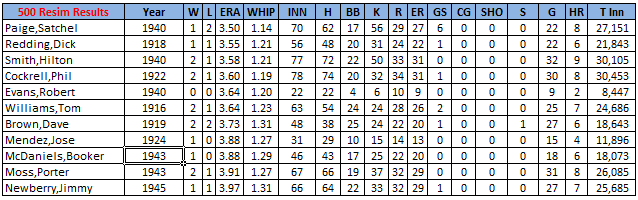
All other relievers are destined for middle relief, and while useful, don’t warrant a full post. Here are there simmed statistics.
Monday, September 24, 2012
Negro League Overview - Center Field
This is an ongoing multi-part series on the new ATB Negro Leaguers that will be available in our next draft. See here for the other parts.

Pretend for a moment we had the ability to take the batting average of Ross Barnes and meld it together with the home run prowess of Jimmie Foxx. We’ll take this player and sprinkle in the ability to hit doubles like Tris Speaker and take a walk like Joe Morgan. For kicks and giggles let’s add a bit of Ty Cobb, and let this player steal 45 of 65 bases each season.
You’d be left with a slash line of .338 / .442 / .625 to go alongside 49 doubles and 39 home runs per season. Oh, that reminds me, let’s also give this player Ex/55 defense with a Vg throwing arm and plop him down in the most demanding outfield position, Center Field.
That my fellow owners, is what you would call the new first overall draft pick. And that is exactly what we have in 1924-1925 Oscar Charleston.
His bio at the Baseball Hall of Fame says it all:
A multi-talented star, Oscar Charleston was renowned by those who saw him play as the finest all-around player in Negro league history. A barrel-chested, left-handed hitter, the fiery Charleston hit for both average and power while revolutionizing defensive play in center field. His blazing speed, aggressiveness on the base paths and focused intensity led many to compare him to Ty Cobb. In 60 league games in 1921, he batted .434 while leading the Negro National League in doubles, triples, home runs and stolen bases.
Corner outfielder and teammate Dave Malarcher once said, “Some people asked me, 'Why are you playing so close to the right-field foul line?' What they didn't know was that Charleston covered all three fields, and my responsibility was to make sure of balls down the line and those in foul territory.”
I believe Charleston is worthy of the top draft pick. Babe Ruth and Barry Bonds are plainly better hitters; and Ted Williams still has over 30 point lead in on base, but only at the sacrifice of 20 doubles. Last year owners mused that perhaps Mickey Mantle was the most deserving of future #1 overall draft picks. Charleston is better than Mantle, both with the stick and with the glove. According to the resim data, Charleston is now the third best hitter in ATB, but with such tremendous defense he is an overall gem, and an argument can be made that Babe Ruth has been supplanted.
He wasn’t the only center fielder worthy of starting role. Cristobal Torriente recorded an OPS of .819, Pete Hill managed .802, and Bullet Joe Rogan .794. For their part, Torriente and Hill are almost identical, and look like either a less powerful Ty Cobb or a more powerful Tris Speaker.
Center field just got a whole lot deeper.

Sunday, September 23, 2012
Negro League Overview - Right Field
This is an ongoing multi-part series on the new ATB Negro Leaguers that will be available in our next draft. See here for the other parts

Right fielder's in All Time Baseball, and by extension the major leagues, has historically played as the weakest hitting position among the three outfield spots. Weakest hitting in terms of OPS anyway, right fielders continue to hit home runs at the prolific rates. The additional Negro League’s candidates played much the same way.
Heavy Johnson was exactly what his name suggested. His 250+ pound frame allowed for great power but little agility, and while a liability in the field, Johnson slugged with the best of them. In his rookie season Johnson won the Triple Crown, batting .406 with 20 home runs and 120 RBI. A teammate claimed that the bulky outfielder was once sleeping on the bench when he was awoken and told to pinch-hit; he grabbed a fungo bat and hit a home run.
In the 500 resims Johnson recorded the second highest OPS among right fielders, behind only Babe Ruth. His 1922-1923 seasons resulted in a powerful line: .317 / .364 / .585, with 48 2B, 16 3B, and 31 home runs. With a Fr/145 defensive rating, Johnson should end up as a DH; only the most daring (read: reckless) owners will allow him to play the field for any length of time.
Among the total player pool (not just right filders) Johnson is unique. Others have greater power, still others have better on-base skills, but few combine both qualities into a single player. The great sluggers of ATB – Ruth, Bonds, Gehrig, Williams – each had on base averages 70, and sometimes over 100, points better than Johnson. On the other hand the great bashers of the game – McGwire, Stargell, Greenberg, Foxx, etc – recorded on base averages well below Johnson’s.
He is an obvious first rounder, but as a DH and a step below the ATB elite, it will be interesting to see where owners draft him.
The only other right fielder that might be worth a starting position is Mules Suttles. A Hall of Famer, Suttles was one of the best hitting Negro Leaguers of all time. At his best he hit for average, power, and had the ability to draw walks. From 1926 to 1931 he averaged an OPS over 1.000.
In the resims Suttles kept the power but little else. He batted .254 / .301 / .480 but with a Pr/65 defensive rating he will likely end up as another DH. He is almost identical to 1966 Dick Allen, hitting a bit more doubles while giving back a similar amount of home runs.

Subscribe to:
Posts (Atom)